LIFE IN LONDON #06

I knocked on his door, an ornate blue slab of wood flaking from neglect, and heard movement from inside the residence. This was already a win — it meant my patient was home, could hear my knocking, and was capable of moving around the house. The door-knocker’s trifecta.

When the door opened, I was surprised to be met by a younger man (younger being anything under seventy) of around fifty-five who squinted at me through blurry eyes set too-close together over a vein-tattooed nose.

‘Good morning, I’m Jonathan, the community phlebotomist. You must be Gerald?’

He gave the question thought as if unsure of who he must be, before asking,

‘What’s all this then?’

I wondered if I’d gotten the wrong address.

‘You are Gerald?’

‘Yap.’

‘Gerald, I’m Jonathan, I’m here to take a blood test.’

‘I don’t know anything about all this. Come in.’

I was surprised, expecting further resistance from a man with no knowledge of a scheduled blood test and a stranger showing up at his door welding needles.

‘Okay.’

I followed him through his dimly lit hallway, further narrowed with a collection of boxes, clothes, and assorted piles of what can only rightly be called trash. He stepped into his kitchen, the food-preparation based equivalent of his hallway, and plonked down in a seat by a dining table, picking up a glass of apple juice and taking a drink.

I slung my backpack onto the table and withdrew my yellow sharps container and the pre-prepared pouch of needle, tourniquet, blood vials and cotton ball. Gerald squinted at me again and asked,

‘What’s all this then?’

I had a feeling of déjà vu.

‘Ah, the blood test, remember?’

‘I don’t know anything about all this.’

‘I’m guessing your doctor ordered some tests to be done. Have you see your doctor lately?’

‘No! I haven’t seen anyone in, oh…’ He trailed off, apparently forgetting he was talking mid-sentence and took another drink of his juice.

‘Someone should have rung you yesterday to let you know I was coming. Did you get a phone call?’

Gerald shrugged. ‘I don’t know. Maybe I did, I wouldn’t remember. I’m a drunk.’ He took another sip of what I was quickly realising wasn’t apple juice.

I stopped the preparation of my equipment, stunned slightly by his completely unabashed confession.

He didn’t say it like it was something he partook in, he said it as a title, like how I imagine a pilot would introduce themselves. “Good morning, I’m the pilot.”

Only in Gerald’s case he wasn’t in charge of piloting us south-west at 10,000 feet, he was steering me through the booze-addled maze of his poor logic and patchy memory.

I pulled on a pair of gloves and he glanced at the needle and tubes now neatly arranged on his tabletop.

‘What is all this?’

Now that I knew what I was dealing with, it was easier to handle. ‘I’m taking a blood test, remember?’

‘No. But I suppose I wouldn’t. I’m a drunk. Do you want a drink?’

I tipped my head side-to-side, giving the question serious thought. ‘That’s very generous, but I better not.’ My eyes went instinctively to my watch. It was ten o’clock in the morning.

‘Sorry I’m drunk,’ he said, unapologetically.

I shrugged and wrapped a tourniquet around his upper arm. ‘It’s your house.’

I instructed him to keep his arm still as I swabbed his skin and aligned the needle, slipping the splinter of metal into the curve of a vein. A flash of blood appeared in a tiny chamber at the base of the needle. I slotted the first vial into a canister and watched as a dark line of maroon snaked down the thin tubing, filling the glass container.

‘What’s all this, then?’

The query was calmly asked given, to Gerald, his memory had just reset and he’d blinked awake to find a young man draining his blood. I respect that in a person.

‘I’m taking some blood samples your doctor ordered.’

‘I haven’t seen my doctor in months.’

I didn’t have it in me to explain again. ‘Weird, that.’

‘Well, maybe I did. I forget things. I’m a drunk.’

He went to reach for his glass and I clamped my hand on his, stopping him from moving it, dislodging the needle and bleeding all over he table. He blinked at where I clutched him, and then stretched out with his other arm and took a swig of wine.

‘Do you think that would affect my memory?’

I pulled the needle from his arm, pushing a cotton ball to the site and taping it down, and then snapped of my gloves.

‘Alcohol abuse can affect memories, absolutely. So I’d say that has something to do with it.’

‘Yeah, I’d say,’ he said, leaning forward and chortling a laugh as if we were sharing a joke. I didn’t want to be rude: I laughed too.

‘Well, we’re all done, my friend,’ I said, packing away my things and slipping my backpack on. ‘Thank you for your time, and your blood.’

I headed for the door and reasoned he had probably donated just as much alcohol as blood. Given his state of inebriation, someone could use his blood samples as smelling salts.

I reached for the door handle and was about to make my escape but Gerald was too quick for me.

‘I still don’t know what all this is about!’

‘I took your blood, Gerald!’ I said, dropping all tact.

‘Oh. Okay. Thanks then.’

‘And thank you, Gerald. I’ll leave you to it, mate.’

‘Right,’ he said, easing the door closed. ‘It’s about time for a drink.’


When relocating to London, I moved in with my cousin, Dom. Dom is a primary school teacher, and has spent his time in England working throughout different schools. He also has a blog, and has recently written an excellent piece about an intense conversation he had with a student. It’s worth a read, and worth a click of your mouse.

Click here to read: http://29andprimed.weebly.com/blog
JOURNAL EXTRACT #09

I am sitting in a sun-strewn park in Barcelona in the shade of the Sagrada Familia on a bench with my brother reading beside me. So much about that sentence makes me happy. That I am in Spain, that it is sunny (the four-thirty pm sunsets of London were a novelty for exactly one day before they just became depressing), that I am in the presence of an incredible man-made structure, and that I am reunited with my brother. And that he’s reading, because, you know…books are awesome.

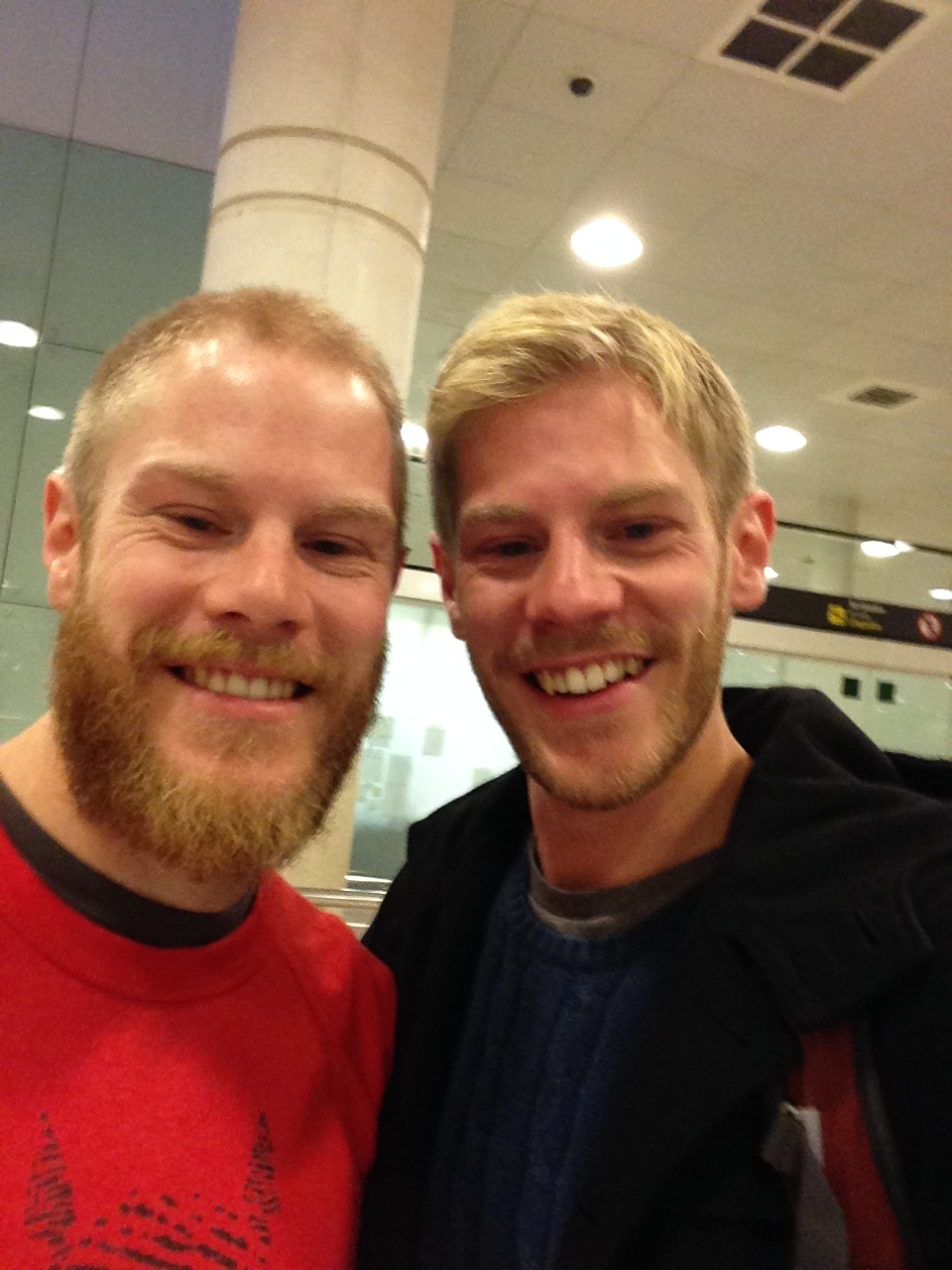
It’s kind of mad when I think about the fact that Damo pulled on shoes in his side of the world, sat in a car, boarded a plane, then skipped his way across countries and oceans (three planes and two countries for those playing at home), while I pulled on shoes in London, train-hopped to the airport and flew out of England, and that our paths, which had diverged for the past four months, came together again. That in this ridiculously huge globe filled with an infinity of spots, Damo and I crossed an airport, hugged, shoe-tips touching, in the exact same spot in Barcelona. Life is fucking amazing.

IMG_1468

For the official record, four months is the longest we have spent apart. And it’s not that we’re the clichéd co-dependant twins that dress the same and finish each other’s sentences, the ones that creep you out a little and you avoid on the train. We’re normal. We hug a little too much, and laugh hysterically at each other’s jokes until you wish that you had avoided us on the train, but besides that, we’re regular guys. The reason we’ve never spent more time apart isn’t because we’re twins – it’s because we’re friends. We hang out. And the fact that we lived together for the first eighteen years of our lives, and intermittently in the intervening years since, also helped maintain our attachment.

When I decided to dig myself out of Australia and replant myself in London, we knew it’d suck not to hang out, but that we’d be okay. We’re our own people with our own lives, and our own wardrobes – we’d survive.

But I have missed the man immensely. It’s not until you’re away from someone that you realise how much of your own identity and self-assurance stems from relationships like the one I have with my brother. Every time he laughs at a joke, he validates that I’m funny. Every time I share a thought and we discuss it, he validates that the thought was worthwhile. Every time I have an interest that he shares, he validates that interest. And every time, and I mean every time, I suggest we go get a pizza, he validates that we should in fact go and get a pizza. It’s a bond we share.

Needless to say, it’s good to be enjoying his company again. To be enjoying it in the beautiful city of Barcelona is icing on the cake. Or maybe I should say chocolate on the churros.

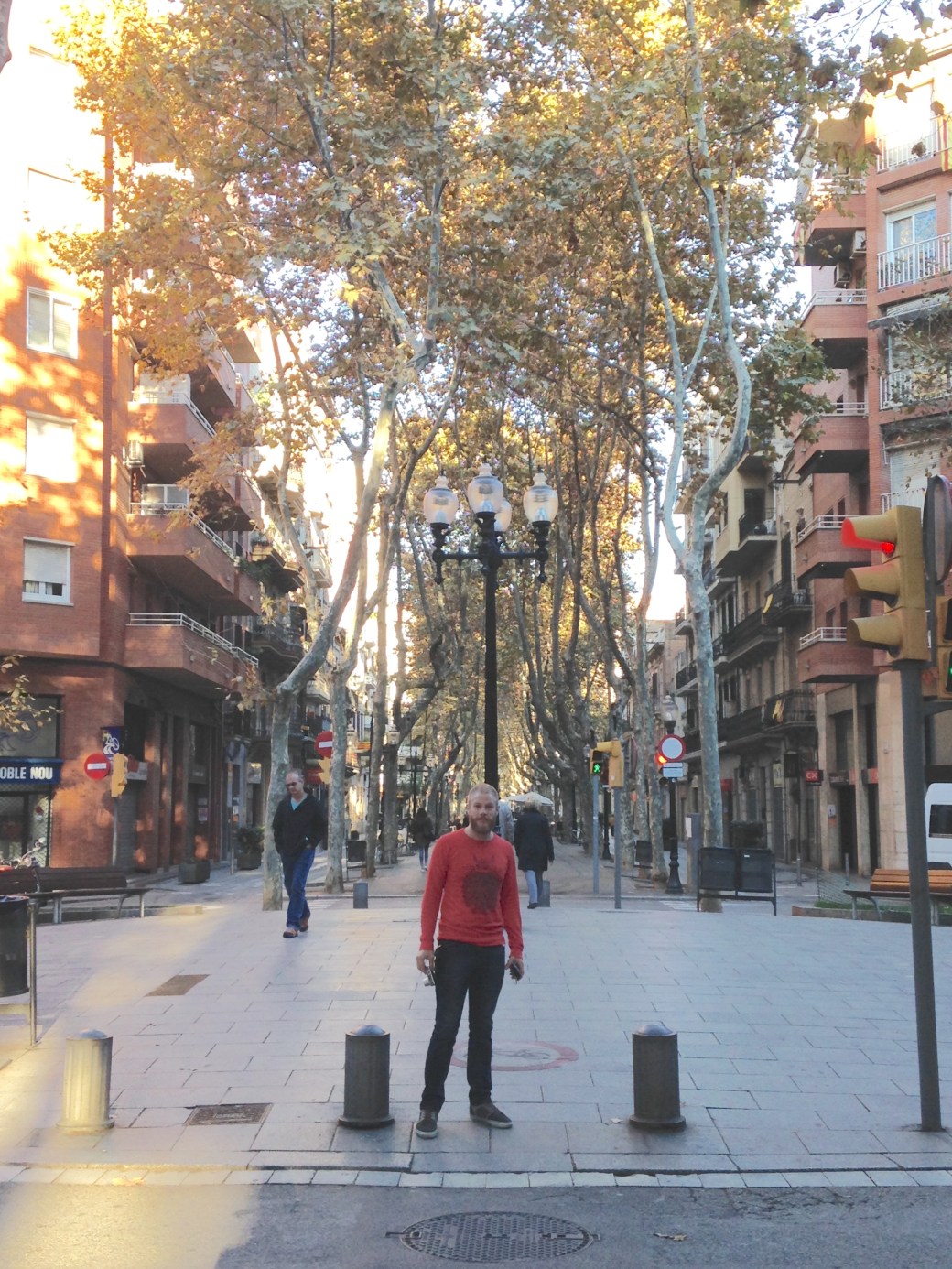
We arrived late Saturday night and taxied it to our hotel, found our room (two single beds – I told you we were normal), then headed out for some food. Literally around the corner from out hotel is a street called Rambla del Poblenou, which is an open stretch of tree-lines road spotted with restaurants. We found a place selling €1 sandwiches and fries, and got to work. The beer was also €1. And just like that, Barcelona had seduced us.

FullSizeRender

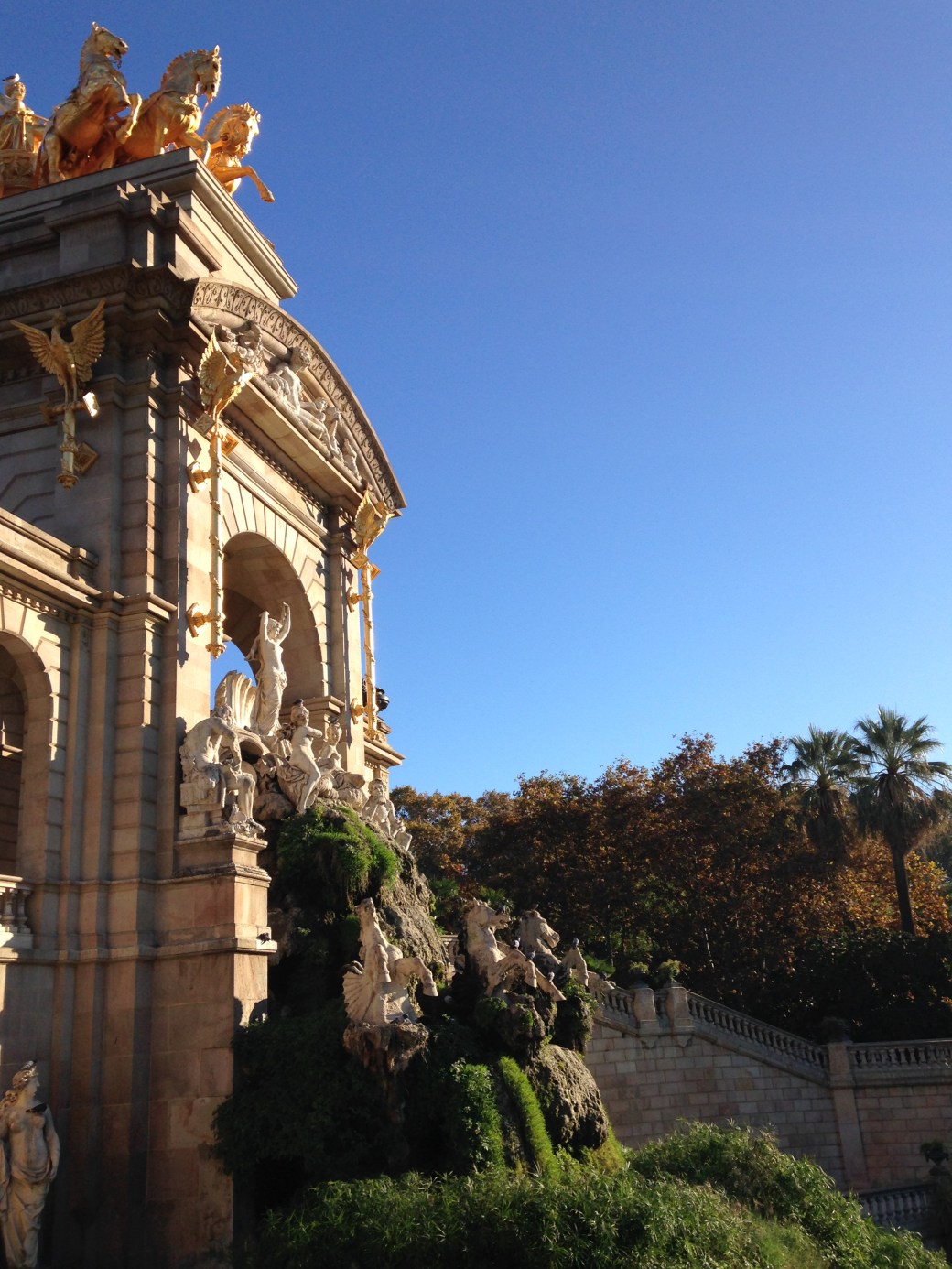
It’s now Tuesday and in the past two days we’ve explored parks bursting with greenery and stunning fountains, tagged along on a walking tour through the gothic quarter of Barcelona, seen ancient Roman ruins, eaten mouth-watering paella, strolled the docks, and pretty much stumbled onto every incredible landmark this piece of Spain has to offer. We’ve also swung on the truck of a Mammoth statue, because, when in Rome…

12240059_10153550628570589_4772510747027999272_n

Barcelona is an artistic city dotted with old-world tenements and modern architecture. The food is fresh and tasty, and, excluding the fact that some of them take it upon themselves to lighten your pockets, the locals have been friendly people. So far my pockets have remained unpicked, and I thank my skinny jeans for this. I have a hard enough time getting my wallet from my pocket, I figure a thief stands no chance. I bet pick-pocketers the world over gave up and got real jobs when skinny pants came into vogue.

IMG_1492

I’m going to sign off here because the Spanish sun has made us warm and we’re going to go get an ice cream before our tour of the interior of the Sagrada Familiar.

Hey, what do you know, that sentence made me happy too.

IMG_1503

PATREON

I am a writer. This is how I perceive myself because this is the thing I’m most passionate about. It’s also the thing I’ve spent the most time working towards. Ever since Year 9 English when the class was instructed to write a five-hundred word piece of creative fiction and I handed in a short story of one-thousand, two-hundred and six words to my poor over-worked teacher, I knew I wanted to be a writer. I left school knowing this and did a writing course to chase this dream down and grapple it into a reality.

But, I am also a nurse. I’m a nurse for two primary reason:

  1. I wanted a job that exposed me to the world’s realities, that showed me stories, and that let me connect with people in a deeper sense than the superficial, “How are you? I’m good,” sort of way. A job I could respect and be proud of. A job that let me help people.
  2. I also needed the money.

I don’t like the latter fact, and I don’t like that the latter fact is a motivator in my decision-making process, but that doesn’t change it from being a fact. The world is expensive and often unforgiving in this regard, and I can accept that if I want to live in the modern world, it comes at a cost.

But ideally, this fact would be addressed by my writing. To be able to make money from my writing, to fund writing with writing, is the dream fifteen-year-old me had back in high-school. It’s what I’ve been working towards for the past fourteen years.

But working full-time as a nurse leaves very little time for sitting and writing, to dedicating myself to the craft I love. After years of working as a nurse and collecting stories from the people I’ve worked with I’ve reached the point where I want to shift away from gathering stories and towards sharing them.

Because of this, I’ve joined Patreon.

Patreon is a website built around providing artists with an outlet for their work while also allowing them to obtain payment for their art. It works like this:

I upload short stories or chapters from my novels and people can subscribe to be a patron at a price of their own choosing. Patrons pay what they want for the uploaded work — a dollar, fifty dollars, or nothing at all, they can have it for free if they like. It’s a way of my work getting out their, people getting entertainment and enjoyment from it, and a way for readers to support the writers they love.

If you wish to read my stories and be a patron, and to support me along the way, please follow the link below:

https://www.patreon.com/jonathanrobb?ty=h

So far one piece of writing, a story called When You’re Older, has been uploaded, but more will follow. For those wishing to read it on a iPhone or iPad, please download the .epub version, or for those who want to read it on a kindle, please download the .mobi version.

Thank you for your support, and for reading.

LIFE IN LONDON #05

I scanned my list of names again and found her address. The number matched the rust-bitten silver digits screwed into the black door and I consulted my paper to find her flat letter. I leaned on the “A” doorbell and stepped back, waiting for the little box beside me to squawk into life with my patient’s voice asking who it was.

I locked eyes with a landscaper working in the neighbouring garden and flashed him a smile. He nodded, a recognition of a fellow community worker navigating the maze of London houses and apartments.

When the response finally came, it wasn’t from the direction I’d anticipated. The metal box remained silent and instead a wavering voice drifted down from above.

‘Hello. I’m up here.’

I glanced up to find a thin elderly woman in her nineties leaning out from an upstairs window, a bird-like hand waving at me, and a toothy smile grinning down at me. It was instinct: I waved back.

‘Hello,’ I said, remembering why I was there. ‘I’m Jonathan, the community phlebotomist. I’m just here for a blood test. You must be Catherine.’

‘Oh, right you are. I’m not good on my feet. I’ll have to throw the keys down.’

‘Oh.’ This was new. ‘Okay, sure,’ I said to an empty window, my patient already disappearing inside.

I rocked on my heels, waiting on a stranger to throw her door keys at me, and shared another look with the landscaper. I gave a weak smile and glanced away, repressing the urge to tell him this isn’t how it normally went.

After five minutes the frail face reappeared in the square of window frame. ‘Oh good, you’re still there. I’m throwing them down now.’

I raised my arms above my head and clapped my hands. ‘Go ahead,  I’m a good catch,’ I said, then felt an absurd surge of anxiety that I’d drop them with the landscaper watching. I couldn’t tell you why I wanted to impress a stranger with my key-catching abilities, but there it was.

Catherine gave a little flick of her claw of a hand and the keys hung in the air. I traced the arc of the descent with my eyes and my hand snaked out, snatching them from the sky with a contraction of my fist. I felt a flood of elation and sneaked a glance at the landscaper to see if he’d seen. He gave a raise of his brows and I shrugged like it was no big thing.

‘It’s just the one by the handle, and then the bigger one unlocks the lower lock.’

Catherine’s words snapped me from my victorious reverie and it occurred to me to put the keys I was still holding aloft like a trophy to use. I followed my patient’s instructions, unlocking deadbolts and locks with keys straight out of the Victoria era, big fat keys with the small square of teeth at the end. I stepped inside and into an apartment that could have been lifted from a Sherlock Homes’ novel. Sunlight filtered through the dusty air and a rug-lined staircase twisted up through the wooden foyer to the bedroom above.

I mounted the stairs and found my patient sitting in her nightie and dressing gown on a two-seater couch that looked as old as she was. She looked small in the big bedroom instead of the image I previously had of her hanging out a window.

‘Catherine, it’s nice to meet you,’ I said, handing the keys back, stupidly triumphant in this exchange of property, as if it was a challenge I had risen to and won.

I slipped into my role of health carer, providing the necessary small talk and questions while simultaneously preparing equipment and poking this sweet old lady with something sharp. If done well, you can have your patient more absorbed in the conversation than the act of taking blood, and they’ll swear afterwards that they didn’t feel a thing, even if in the moment they winced as the needle pierced flesh. This I treat as a real triumph — the ultimate victory.

I completed the necessary paperwork and Catherine fell silent as I worked. When finished, I looked up to find that she had a portable phone in her hand.

‘The council are always so hard to reach,’ she said.

‘Tell me about it,’ I replied while slipping on my backpack. While I’d never tried to reach my local council in London, I felt I’d waited on-hold long enough with equivalent organisational bodies to share an eye-roll at the ineptitude of Catherine’s local council.

‘I just ring the gas-leak number,’ she said with a wicked and satisfied little smirk I wouldn’t have believe this old dear to be capable of, and she pressed dial on her phone.

I laughed and gave her a silent tip of the hat, and as I waved her goodbye and turned to head down the stairs I heard this exchange:

‘Hello! No, no, there’s no gas leak. I just need more of those green compost bags…Oh, you could? Oh, well, thank you, dear.’

As I made my way down the stairs I couldn’t help shake the feeling that there was a lot Catherine could have taught me about navigating life in London.

LIFE IN LONDON #04

In the old days (by which I mean a few months ago when I lived in Australia) I used to work as a district nurse. This involved driving from patient’s home to patient’s home and providing nursing care in the person’s own environment. The work day would finish by heading back to the office and sitting around a table with my peers and having a serious discussion about our patient’s needs. It also involved having a not-so-serious discussion about the absurd things we’d come across that day, each of us trying to best each other’s latest edition of the bizarre things humans are capable of.

Working in the community opens you up to a plethora of (what’s the politically correct way of phrasing this?) “interesting” people. These are the people who treat social norms as more of loose guidelines than hard-and-fast rules. Normally, this is a good thing. Life would be boring if we all behaved the same, dressed the same, and said the same things. Unfortunately, some of these patients take it too far, and dismiss certain social norms that are norms for very good reasons. Let me give you an example to help clarify what I mean.

One day a friend of mine told me casually over the work table that she’d been met at the door by her patient, a middle-aged man, “windmilling” his penis at her. I think he was wearing an open robe, but it’s equally likely he was stark naked. This is one of those times where the social norm is beneficial for everybody — let’s stick to shaking hands instead of shaking alternative appendages.

For anyone wondering, I think the term “windmilling” was invented by my friend, and I find it brilliant because right now everyone reading this has an image in their head of exactly what took place. You lucky things.

This is the first example that came to mind, but rest assured there are many more. From a smoker with a chest wound that puffed out cigarette smoke every time he coughed, to a woman dressing in a garbage bag while having her catheter changed to preserve her dignity (mind you, a hole had to be created to get to her catheter, so I’m not really sure what this achieved).

A colleague who has worked as a nurse for over thirty years once said to me that she wished she’d written some of these stories down, that for all the ridiculous tales she could remember there were twice as many she’d forgotten.

Now that I’m in London and doing essentially the same sort of work, I thought I’d learn from my friend’s hindsight and pencil some of the stranger incidences down.


From the outside, the block of apartments looked dignified. Ancient trees drooped limp branches over the grass ringing the building, and the flats were constructed of old brick begging to be strewn with a lace-work of ivy. I read the name from my sheet — Patricia — and pictured the sweet old lady that belonged to this sweet old building, already looking forward to her proper accent and polite ways.

I walked around the apartment block and found the line of buzzers by the exterior door, checking her number on my list of patients and pushing the button. A few seconds later, there was a mechanical whirr and a click, and I pushed on the door and stepped into the stairway. It was dank, but it’s London, so that wasn’t particularly unusual. I climbed the creaking wooden stairs, scanning door numbers until a green door bearing the appropriate digits stood before me, and I rapped on the wood.

Footsteps sounded from inside the apartment and I straighten my coat, wanting to make a good first impression. Appearances can say a lot, after all. The door opened and I blinked, my introduction falling from my lips on instinct.

‘Good morning, I’m Jonathan, the community phlebotomist.’

An adult diaper covered her crotch and buttocks, but everything else from her flabby breasts to her varicose-veined legs were on show. She was younger than I’d anticipated, around sixty-five, although from what I could see, time had not been kind to her. She smiled at me, a toothless smile revealing gums as naked as the rest of her, and she asked, ‘Are you here for the blood?’

‘That’s me,’ I replied. She seemed completely comfortable with her attire, entirely unperturbed at being barely clad in front of a young male stranger. I felt the weird sensation that it would have been rude of me to make an issue of it.

She waddled down her dark hallway and into her cluttered living room, saying over her shoulder, ‘You’ve caught me in my nappy.’

‘I can see that,’ I said, moving into the room and inhaling the scent of years of cigarette smoke soaked into walls and floorboards. Her house was stifling from the warmth of her heater, and I pulled off my jacket before I began to sweat. A method of cutting down on her heating bill occurred to me, but I decided not to mention it. I reasoned that I had obviously interrupted her preparing for the shower, and wanted to give her an out. ‘I not bothered by it if you aren’t.’

‘No, I’m not bothered.’

‘I’m happy to wait,’ I said, sliding my backpack to the ground, letting the implication hang in the air that the time spent to put clothes on was no burden to me.

She plonked down onto the couch, plucking an already lit cigarette from an ashtray on a coffee table and took a drag. ‘Wait for what?’

That was when I realised she obviously wasn’t putting clothes on, and just as obviously hadn’t been preparing for any shower.

‘Never-mind,’ I said, smiling at her, and wondering exactly when it was this woman had last showered.

With an internal shrug, I went to work going through the routine of preparing my blood-letting equipment while keeping up a stream of small talk. For those of you who have never attempted to take blood from an elderly woman wearing nothing but a diaper, I can tell you, it’s a distracting process. It’s hard thing to carefully thread a needle into the twisted and constricted veins of an actively smoking patient while her breasts are bobbing in your periphery. I had to bite down the urge to ask “Are you sure you wouldn’t be more comfortable with clothes on?”, the subtext of the query being that I sure as hell would have been more comfortable if she’d put some clothes on.

Luckily for me, Patricia was as unbothered by the situation as she had stated, and merrily nattered away, as comfortable as a babe in her crib. Which is ironic, because that’s exactly what she looked like. Well, an ancient over-sized baby in a nicotine-stained couch, but it equates to the same thing.

Once I had pierced her vein and drained the required blood, I taped a cotton ball to the site and pressed the fingers from her opposite arm to the cotton ball, instructing her to apply pressure for at least a minute. She kept up her flow of conversation while I squatted on a stool and wrote her details in the microscopic space provided on the tubes. It wasn’t until I was done that I looked up and found that she was bleeding.

The minute I had asked for her to apply pressure had lasted for as long as it’d taken me to glance away, and blood had seeped out from the small hole I’d created in her vein.

‘Patricia, you’re bleeding.’

‘What?’

She lifted her arm and revealed a red puddle running down her arm and pooling on her thighs. I instructed her, again, to apply pressure to the cotton ball while pulling on another pair of gloves and got to work cleaning her up.

A bleed always looks worse than it is and it didn’t take long to mop up the spilled fluid from her arm and thighs and have her back in her not-so-clean state. She smiled at me, that naked-gum smile to match her outfit, and thanked me.

‘No problem, Patricia. It turns out it was a good thing you weren’t wearing any pants,’ I said, raising my brows and nodding at her recently blood-smeared thighs.

‘Yeah,’ she answered cheerfully, ‘it really was.’ She seemed proud of this, as if the decision to wear nothing but a nappy had been a genius stroke of forethought on her behalf, rather than the neglect of a very basic human desire to put on clothes. I let her have it — I figured an adult who spends their day walking around their home in an adult diaper didn’t get many wins.

‘Nicely played,’ I said, shrugging on my jacket and giving her a wink, and immediately reflecting that winking at an almost naked elderly patient probably wasn’t the smoothest thing I could do.

I said my farewells and waved goodbye to my new nudist friend, stepping back into the stairway and making my way out into the fresh air and away from the tropical heat and cigarette-perfumed environment I had just left with relief.

As I found the address of my next patient and begun trudging away, I looked back over my shoulder at the beautiful English building I had just left. It really did look quite dignified.

But looks can be deceiving, I suppose.