Raising Roo: Birth Story (Part 2)

I meet the midwife on shift, a friend of our midwife, who explains that Christina had rang ahead and ensured Alex was hustled off the ward and into the birthing suite as soon as possible. I thank her profusely for reducing our apart time, and reflect that, once again, in Austria, it’s all about who you know.

The midwife explains the current options, all of which boil down to different ways of waiting, and Alex goes with the most comfortable sounding: a bath. The suites are fitted with a private bathing room containing a circular tub the size of a spa. The midwife gets the water running, provides some towels and shows us the adjoining bathroom, and then leaves us to it.

Alex disrobes and eases into the water, her tight pregnant belly glistening, and it still doesn’t feel quite real, even here and now, that a baby is ready and waiting inside.

‘Do you want me to get in with you?’ I ask, winking.

‘I don’t know how the midwives would feel about that. They’re used to dealing with naked women, not men.’

I sigh. ‘All the perks go to the pregnant lady.’

‘Damn right.’

We talk, conversation broken regularly every time Alex has to focus on another contraction and I get to practice my encouraging breathing instructions. She says that the warm water is helping, but it feels as if they’re getting stronger. 

I bring out a bluetooth speaker and we listen to George Ezra strum his brand of upbeat pop, Alex soaking in the bath and me on the floor, one hand dangling in the water, waiting for our baby to arrive. 

After an hour, the contractions step up a notch and the discussion and laughter starts to thin out. The pain has increased to the point that she cannot keep talking, cannot keep the thread of conversation. I default back to a string of reassurances but can see their effect lessening with each new spasm. 

At a little before seven, Alex is towelling herself off when Christina arrives. We both soften a little with relief. The hero is here to make everything better. Which, of course, is an unfair expectation as a baby still has to pass through my wife’s genitals and there is little Christina can do to bypass this. Nevertheless, her presence and positivity is a comfort.

Half an hour later and that comfort is dissipating under the ceaseless strain each new contraction is demanding from Alex. She’s hunching now, all efforts directed towards taking long slow breaths through this latest wave of squeezing pain.

‘Any reason they’re coming so fast?’ I ask Christina.

She shakes her head. ‘The body is in charge, and every body is different.’

Christina suggests an examination to get a gauge of where we’re at. Alex lies down on the mattress, once again dressed in an oversized black t-shirt, and I sit at the head of the bed. I hold her hand and give a hopeful squeeze that all her efforts will result in good news. Alex squeezes back, but I think it’s more due to pain than optimism.

‘One centimetre,’ Christina says, and the announcement hits me like a splash of cold water.

I think of all that Alex has given already and multiply that by ten, the magic number before anything can start happening, and feel a heaviness in my gut. I catch her eye and force a bright smile.

‘Progress,’ I say. ‘Only nine more to go.’

She gives a weary grin but the expression is cut short by another contraction.

Once she is breathing normally again, Alex sits up. I’m watching her closely and see the colour drain from her face. She purses her lips and lets out a long stream of breath.

‘I don’t feel so good,’ she says.

‘Do you want to lie back down?’ I ask.

‘No. I want to go to the toilet.’

She stands but pain ripples through her middle and I grab her elbow for support. We shuffle out of the room together, Alex’s weight pulling more at my arm the further we go. 

‘I really need to get to the bathroom,’ she says, a touch of panic in her voice.

‘Almost there.’ I pull open the heavy door and guide her past the round bath and towards the bathroom.

She shambles out of my grip and stumbles against the toilet door, banging it open and dropping to her knees. The sound of retching follows, deep and guttural, the type of heaving that seems determined to scrape away her insides. The contents of Alex’s stomach erupt out of her and continue to do so until she is rung out.

‘I missed the bowl,’ she says in a croaky voice.

I look over her shoulder from where I was rubbing her back and note that the bathroom contains a sink, a bin, and a toilet, and that she had managed to miss all three. I decide not to share this observation.

‘Why don’t you go sit down. I’ll clean this up.’

Alex gives an exhausted nod and pads back towards the bath. I find a cup and fill it with water from the sink and carry it to her, then get to work with some paper towels and disinfectant left on top of the cistern. By the time I’m done, a little colour has returned to my wife’s face, but pain lines have set up camp around her eyes and mouth.

‘Are you okay?’ A pointless question I can’t help but ask.

She shakes her head, the formation of words proving too much.

We get back to the birthing suite and fill Christina in on what she missed, and she suggests we try walking around the ward to ease some of Alex’s discomfort. Alex concedes with a worn-out nod. The three of us venture into the large open space between rooms, Christina on one side and me on the other, with Alex hunched over between us. 

We don’t get far before Alex stops, fingers tight around our arms, trying to breathe through the iron grip of her uterine muscles. Christina and I garland her with praise and encouragement, and try to coax her further, but progress is slow and it’s not long before she is waving us off, silently pleading for a rest while she hunches against a work desk, arms crossed against the smooth surface and head hanging in between. 

The contractions come back-to-back without any respite to allow Alex to catch her breath and detense. I squat beside her, trying to look up into her face.

‘You are doing great, babe. That’s perfect. Long breath in and long breath out.’

I enact my instructions, breathing with her, and she follows along, face scrunching up and cheeks ballooning as she exhales. She opens her eyes and looks so very tired. She has become increasingly non-verbal and it’s making me nervous. My brain feels like a bird flapping up against a cage, wanting to shout out that something is wrong, that my wife is in pain, but everyone is behaving as if it’s normal so I have to believe that it is. I attempt to quiet the manic bird and smile and rub Alex’s back and prompt her to take a step.

We manage to cross the length of the ward, a weird shambling six-legged creature letting out a jarring combination of painful moans and upbeat assertions. Alex is wrecked by the end of this journey. She leans into a sink mounted on the wall and I ask if she is going to be sick again. She only shrugs and sags lower.

Christina spots a physician and excuses herself. We are alone in the hallway and I want to do something to make the situation better but my options have shrunk to cheerleader and backrubber. I have never felt more useless to my wife. She is bearing this physical burden for us and I am repeating the same sentiment I’ve been saying for the past hour. I’m amazed she hasn’t asked me to shut up yet.

Christina returns. ‘The doctor said he’s been watching you and believes you’re ready for an epidural.’

I feel a flush of satisfaction that Alex’s painstaking parade has been good for something.

‘Is that something you’re still wanting?’ Christina asks.

Alex looks up with dark hollows under her eyes and breathes out, ‘Please.’

We start-and-stop our way back to our suite, moving with the tide of her contractions, until Alex finally collapses onto the edge of the bed. I expect to see relief in her face, but sitting hasn’t eased the waves of pain squeezing her body. Her entire focus is committed to enduring.

‘Just a little longer, beautiful, and then they’ll numb you right up. You won’t even know you have a uterus by the time they’re done.’

She gives a fluttering smile at my weak attempt at humour then returns to her ordeal. 

It takes another forty-five minutes of deep breathing and moans trickling from pursed lips before the anaesthesiologist and his resident arrive. I am given blunt instructions to leave the room; COVID restrictions separating us again. My caveman side wants to thump my chest and tell him ‘Make me,’ but I concede after giving Alex one more pep-talk and a kiss to the forehead.

The door slides closed and I stare at the white surface for a while, picturing my wife exposing her back for the needle, before turning to the open ward. 

I stay within a five metre radius of the room, wandering out to my self-imposed limit and then snapping back. I lean against the wall beside the door, and then the door itself, and then stride out again, restless. From my nursing experience, I know the procedure should take around twenty minutes, providing all goes well. At the forty minute mark I feel like a shaken up bottle of soft drink with the lid on tight. I bite back the urge to hammer on the door and demand they let me in. I pace my small circle and wait.

Five minutes later the door slides open and the anaesthesiologist and his resident step out, glancing at me before striding away. I rush the room and find Alex sitting up in bed with her latest accessory — IV pole, pump, and tubing snaking under her shirt — erect beside her. She smiles at me and I breathe again.

‘How are you doing?’ I ask, sitting on the edge of the mattress.

‘Better,’ she says.

‘The contractions?’

‘They tell me they’re still there, but I wouldn’t know it.’

Tension is draining from her features and her shoulders have relaxed. It’s good to hear her voice again.

‘Took them long enough,’ I say.

‘I don’t think the resident knew what she was doing.’

‘Just what you want when someone is shoving a needle into your spine.’

She leans forwards until our foreheads touch and we each exhale. The respite feels well deserved.

With the pain under control, we find ourselves unsure what to do next. The morning has been swallowed in a haze of agony for Alex and a fog of anxiety for me.

‘So, what do you feel like doing?’ I ask.

‘I could eat.’

I laugh and know I have my wife back.

(To be continued…)

Raising Roo: Birth Story (Part 1)

‘Babe, wake up. My water’s broke.’

It’s two o’clock in the morning and I’m disorientated, lifting my head off the pillow and looking around with squinting eyes as a bedside lamp blazes to life. I find my heavily-pregnant wife lying beside me, looking down at herself with a faint expression of disgust, then at me, eyes wide and expectant. 

For a second I wonder what she wants, then the fog slips away, the pieces of this jigsaw slide into place, and her words come into focus. I react with the best my sleep-addled brain can manage in the moment. 

‘Oh wow, that’s exciting.’

Not my most inspired effort.

‘Are you okay? Do you feel okay?’ I ask.

‘I think so.’ Her voice is shaky. ‘I don’t know.’

‘This is really happening.’ I give her an enthusiastic grin that she tries to match, but the expression is a little watery, fear butting up against excitement. ‘Do you want to get out of bed?’

‘I think it’s still leaking out.’

‘That’s okay.’

‘It’s all over the bedsheets.’

‘That’s also okay. We can clean it up.’

She nods. ‘Alright.’

Alex eases back the doona and places her feet on the ground while I trot around the bed to help her stand. She grips my arm as she levers herself upright and doesn’t let go as she straightens, each of us looking at the other, her dressed in a long black t-shirt and me in nothing but my own skin, and then to the puddle collected on the mattress.

‘It’s running down my leg. God, that feels gross.’

I’m struck with a bolt of inspiration. ‘Towels!’ I say, relieved I can make myself useful. ‘Are you good?’ 

She nods and I let go of her arm and step into the hallway, grabbing a few of the second-best towels before rejoining my wife. I drop a faded, rainbow-striped towel on the floor between her legs and we watch as more liquid trickles from her ankle and into the material. Her limbs are trembling, muscles overloaded with flood-levels of adrenaline. 

‘Do you want to call Christina?’ I ask.

‘Yeah. Good idea.’ She takes small careful steps, edging around the sticky mess on the floor, and plucks her phone off the bedside table and rings our midwife.

I hover around while they talk, wired from the unreality of the moment but unsure where to direct my energy. I decide that getting dressed is a good use of my time and put on some clothes.

Alex hangs up. ‘She said it all sounds normal. She’s not at the hospital at the moment but starts her shift at seven, so that works out well.’

‘Who knows, maybe the baby will beat her there.’ I wink.

She rolls her eyes. ‘That would be the dream.’

‘So we’re heading in?’

She chews her lip and looks at me. ‘I think I want to shower.’

I laugh. ‘That is allowed.’

I pass her another towel that she wedges between her legs and then she waddles to the bathroom to feel more like a human again and less like a leaky pot. As the gentle roar of the shower starts, I consider the bed, figuring clean sheets will be desired when we next return to this room, exhausted from the marathon to come. And with a baby on the outside of a body instead of within. 

It hits me then, that the countdown has really begun, and in a collection of hours our little family will have a new member. There’s a bubbling in my chest that’s just on this side of uncomfortable and I grin. The concept that’s been housing in my wife’s uterus will soon become a very real reality. I get to changing the sheets.

Alex emerges from the shower looking better, with colour in her cheeks and more steady on her feet. She looks beautiful, healthy and ripe with pregnancy. I hug her and feel my emotions spike for the fourth time in the past twenty minutes. 

She dresses and adds the final items to her pre-packed bag and suddenly it’s time to leave. 

‘Ready?’ I ask.

She gives a big smile. ‘I hope so. A photo first and then we can go.’

We stand together and immortalise the last moment before we become parents.

The city is dim and quiet as we wind through it, skimming along the edges of its heart under the glow of street lamps. The radio plays softly under the burble of our conversation.

‘That’s another one,’ Alex says, hand going to her midriff and pressing before eventually letting out a big breath.

I take note of the time. ‘How regular are they meant to be at this point?’

‘They say roughly twenty minutes apart this soon after your water breaks.’

I frown. ‘That was only around six minutes.’

She shrugs. ‘Lucky me.’

We pass nightclubs still thumping with the bass of dance music and I have never felt more removed from that lifestyle. The roads are all but empty and before long I am pulling into the hospital underground carpark. My heart is thudding in my ears as we get out of the car and I pause to photograph the bay number, sure this information will fall out of my head by the time I return to the car. I sling the overnight bag onto my shoulder and put my arm around my wife and we slowly make our way up to the hospital entrance.

The sky is lit with the dark illumination of light pollution and the hospital rears in front of this ghostly backdrop, foyer bright despite the hour. Two guards, one man and one woman, stand just inside the glass front, enforcing the COVID visitor regulations around the clock. 

Alex totters through the automatic doors, belly leading, and explains she is in labour and would appreciate a room in which to continue this activity. The male guard responds with the most absurd question I can imagine given the circumstances.

‘Do you have an appointment?’

Alex and I look at each other and then she turns back to the guard and explains that, no, she doesn’t have an appointment for three o’clock in the morning on a Saturday, but hopes she can still give birth here despite that. 

The guard briefly discusses this with his colleague, then again on the phone to a hospital staff member, while we wait, Alex taking long breaths through another contraction.

‘Okay,’ the male guard says, nodding at Alex, ‘you can go up. But you,’ he turns to me, ‘have to wait here.’

I feel a hiss of protective anger at being separated from my wife and the irrational urge to push past this uniformed poser and charge the hospital, but this is the caveman in me and the more civilised part of my subconscious reminds me that this situation was not unexpected.

During prenatal check-ups, all of which Alex attended solo as my presence was again forbidden thanks to the global pandemic, we were informed that no visitors would be permitted to accompany the patient until she was taken to the birthing suites. 

‘Okay then,’ she says, smiling through her anxiety.

‘I’ll be sitting right here until they let me up.’

She nods and we hug, and kiss, and then I watch my wife wander into the vast expanse of the hospital, alone.

There are a few tired looking chairs dotted around the glass walls of the foyer and I settle into one while the guards take their own seats at a desk by the entrance. I pull out my phone but am too stimulated to focus on anything and tuck it away again. I take stock of my situation, an Australian sitting in front of a Viennese hospital at three in the morning while somewhere inside my child is stirring inside my wife’s womb. I feel simultaneously connected and disconnected. 

I decide the best use of my time would be to try and nap, to conserve resources for the day to come, and so lean my head back against the glass and close my eyes. An hour passes this way, my facsimile of rest broken with periodic checks of my phone in case Alex messaged and I missed it despite the phone being clutched between my hands.

I eventually get an update saying that the cardiotocography has been done and our little foetus’ heartbeat is strong and steady. My own feels three times too fast. I return to waiting, each second protracted with the knowledge that important things are happening and I am sitting out the front of a hospital with my eyes closed, feigning sleep.

At four-thirty in the morning, the male security guard saunters over and I sit up, ready to defend my right to be here.

‘Robb?’

‘Yeah, that’s me.’

‘You can go up.’

Relief washes through me and I’m standing without realising it. I babble out a thanks while he gives cursory instructions, most of which go past me as I hurry inside, confident I will be drawn to my wife and unborn child like iron to a magnet. 

This presumption turns out to be premature. I gain this insight while choosing from three different banks of elevators, finding lift doors opening on identical-looking floors, trotting down long empty hallways then retracing my steps to the elevator, convinced I should have turned right, not left, when leaving the lift, only be become unsure once wandering deeper into the maze of Austria’s largest hospital.

Finally, while walking down a dimly lit corridor that shows no sign of human activity and convinced I’ve made another wrong turn, I spot the sign for the birthing suites. I press the buzzer and bounce impatiently while I wait for the response. I give my name and my justification for being there, soon-to-be dad, and the glass doors slide blessedly open. 

The ward is mostly quiet at this time in the morning and the midwife at the reception desk points me towards a birthing suite door. I step inside and see my wife and feel the stone in my chest that had been growing steadily larger for the past two hours fall away. She smiles and everything is better.

‘I got lost,’ I confess.

‘But you made it.’ She kisses me.

‘Are you okay?’

She raises her brows. ‘The contractions are coming a lot faster than I expected, but otherwise, all good.’

‘How far apart are they?’

‘About every three minutes.’

‘What? What happened to a slow build up?’

‘Apparently my uterus is in a rush.’

‘Are they bad?’

‘They’re not fun, but they’re okay.’

I shake my head. ‘What a stupid way to make humans. We should follow the kangaroo’s lead and just have them come out when they’re the size of a grub.’

‘Yeah, but then I’d need a pouch.’

I step back and consider her. ‘You could pull off a pouch.’

Alex laughs and runs me through the tests that were done and the action I missed, showing me around the suite, complete with a configurable bed to make any birthing position possible. Outside the window, the city and the sun are waking up, pre-dawn spilling across the sky to herald a new day. A day in which we will have a baby.

(To be continued…)

A couple of kids off to have a kid

Raising Roo: The Cost

Back in pre-baby days when Alex and I were newly-weds talking abstractedly about the concept of growing a human, one of the biggest things that stayed my hand, or in this case, another appendage, was the thought of the cost.

I am a self-confessed introvert (see post ‘Vienna in the time of COVID – Chapter 19‘), which in a nutshell means I like my own company and am content locking myself away for prolonged periods of time, wandering through the words of a book or whittling away at some creative pursuit, such as drawing, crochet, or a blog about parenting. 

Even before beginning the process myself, I was given to understand that, as a parent of an infant, it’s rather frowned upon to just drop sticks and leave in the middle of a diaper change or when your baby won’t stop crying, even though you’ve asked him politely three times to keep it down, because you need a little me-time. In fact, the stark reality is that by volunteering to be the care provider for a helpless, immobile, beginner human, you’re essentially forfeiting me-time for the foreseeable future.

This idea troubled me greatly. At the time, I felt I was performing reasonably well as a husband/brother/son/friend, but knew I was able to give a lot to these relationships because I had the luxury of balancing my community commitments with isolated periods of hermitage and self-indulgence. Granted, my self-indulgence wasn’t anything extravagant, more binge-watching a science-fiction show with a bag of peanut m&ms and long solitary walks with an audiobook than weekends in Dubai and snorting lines of coke off a stripper’s foot (or whichever body part is currently in favour), but these were the activities I needed to keep the Jonathan train chugging along. Without these nuggets thrown into the firebox from time to time, I was concerned the whole locomotive might derail. 

I talked about this with my wife who was sympathetic and supportive, and didn’t just say, ‘Suck it up, buster, and join me in the real world’, which she would have been somewhat justified in saying had she chosen. Even as I talked about it with Alex, and even as I write about it now, I appreciate that this is most definitely a twenty-first century, first-world problem and that historically, and in other countries in our world currently, people are more concerned with earning enough money to feed themselves and their families than with the quantity of me-time they’re allotted.

With this unignorable fact pinging around the back of my head, suck it up is essentially what I did. I wanted to be a father, and I wanted to see what a person that was a milkshake mix of me and Alex would look like, therefore I needed to accept the cost of that decision. 

We were approximately half a year into the COVID lockdown when Alex broached the subject. We had already determined that we would procreate eventually, but knew there were still a few things on our life-before-baby list that we wanted to tick off, such as a trip to Bali with two of our favourite people, Damian and Holly. The trip was originally scheduled for early 2020, but a little something happened that year that got in that way. We naively thought the whole global pandemic thing would blow over in a month and rescheduled the holiday for November of the same year. When we found ourselves still waist deep in virus and November rapidly approaching, we stopped rescheduling, mostly to save ourselves the heartbreak every time our plans got cancelled. Hope may be the thing with feathers, as Emily Dickinson said, but it can also be a bitch.

Alex, normally a lover of plans and the adherence thereto, suggested we ditch the timeline and just jump in the sack together. Technically, she said it a little more eloquently than that, presenting the argument of years lost waiting for the pandemic to subside and the subsequent time spent pursuing those childless-and-free activities we had outlined for ourselves, followed by the time spent trying to get pregnant and our hypothetical ages when we did finally become parents, but it boiled down to the same thing: it was baby-making time. 

Given her persuasive argument, and the undeniable fact that not a lot else was going on, I agreed that, ready or not, we would try and get pregnant. I am not looking forward to the day when I have to explain to Roo that he is just another pandemic baby.

That feeling of the cost still weighed on me, however, mostly that my performance as a father might suffer due to my own inbuilt dependance on bouts of solitude going unmet. In an effort to game the system, I decided that from this point until we saw our little cluster of cells in an ultrasound, I would indulge in my favourite pastimes, thereby storing up a supply of introverted contentment to get me through the lean years. This was not a hard thing to accomplish given COVID meant that not much else was available to me other than lazy activities you can do in your living room. To be honest, by the time the world started opening up again, even this happy little introvert had had more isolation than he could handle.

One other hobby I was looking forward to indulging in was the increased efforts at sparking the candle of life with my wife. We already shared an ease and comfort with each other when it came to amourous activities and this connection only deepened and intensified when we partook knowing it could result in an act of creation. This was unfortunately short-lived as, once all forms of contraception were out of the picture, we had sex a total of two times before conceiving. At least we know we’re fertile.

Alex being pregnant really played into my plans as, not only was she increasingly tired, which further limited our social calendar, she also classified as a vulnerable group, and so our care in avoiding the virus increased tenfold. Our wild weekends, which were tame to begin with, shrank down to afternoon walks along the river, meals at my in-laws, and coffee and cake with friends in the comfort of our living room. By the time amniotic fluid started leaking from my wife, my introverted battery was fully charged.

But the anxiety of the scope of what I was committing to never fully went away, even though my excitement for meeting my offspring was growing exponentially. In retrospect, I suppose it was really the same anxiety every person faces when consigning to be responsible, in body and mind, for a brand new person. The influence such a decision has on your life is monumental, and should be monumental, and the act of bringing to bear what I would no longer have was my way of coming to accept the enormity of what I was devoting myself to: a life-changing experience.

When that moment came, when I saw my son’s face for the first time, his small cries croaking from his tiny perfect mouth, it was indeed a life-changing experience. I know it is cliche to say but I can only report the event honestly as it happened to me: I saw him and knew I would happily pay any cost to be the father of this amazing miracle. He was so little and vulnerable and he only existed because of me, and I accepted the responsibility of caring for him so utterly that to worry about less time rewatching The Office seemed so absurd. 

The scientific thinkers amongst you will no doubt be thinking of the flood of hormones that are programmed to release to invoke these feelings to ensure I don’t get distracted and let my baby be eaten by a crocodile. The psychologically minded amongst you may be contemplating some sort of instant and acute Stockholm Syndrome. Perhaps those with religious tendencies believe I’ve fallen under the sway of a very powerful and very tiny cult leader.

I won’t argue with you. Neurotransmitters most definitely swamped my brain and continue to do so, I fell instantly in love with my captor, and, boy, did I drink the Kool-Aid. But whatever the reason, it doesn’t make it any less true. My free time is almost exclusively devoted to my family and I am more content than I have ever been. What I failed to insert into my equation of effort expended versus time lost to calculate total cost is what I would receive in return. I was focusing on what I would lose and failed to account for what I would gain.

There is no question that parenting is exhausting, and taxing, and requiring of sacrifice, and there have been times in this past year where I have been physically, mentally and emotionally drained. But all I can tell you is that when my son flops down beside me in bed, or smiles up at me when I walk through the door at the end of a work day, or cackles wildly when I blow raspberries on his belly, my battery feels full.

Next week’s topic: Birth Story (Part 1)

Raising Roo: New Roommate

Recently my wife suggested I write a series of posts about what it’s like to have a child. I did a similar thing when the curtain of doom that was the COVID-19 pandemic first descended on all our lives, closing us off from the outside world and forcing us all into the digital sphere, where in my little corner of it I attempted to relate the suddenly universal experience of logging into work in your pyjamas and rolls of toilet paper inexplicably becoming the new gold standard.

So, as our child furniture walks towards the big one year mark, and with almost twelve months experience as an apprentice parent, I decided to take my wife up on her suggestion.

It’s rather fitting that my previous series focused on a viral pandemic, because the experience of first bringing a baby into your home is not too dissimilar. This might sound like a hurtful comparison to make, drawing parallels between a voracious virus that leaves you feeling sick and exhausted and a beautiful new baby boy, but replace the word “virus” with “baby” and you’re not far off the mark. 

Here in Austria, the standard paternity leave is one month, and so for that first month, much like during the early days of the pandemic, my wife and I closed our doors, pulled on our pyjamas, and bunkered down. Instead of becoming obsessed with graphs and tallies of rising case numbers, we found a new obsession in the contents of nappies and the secretions from my wife’s breasts. Rather than watch governmental updates and bingeing on Netflix, we watched the rise and fall of our boy’s chest (still breathing = successful parents) and binged on the curves of his perfect round face. Rather than acquiring the new skills of baking bread or mastering Zoom calls, we became experts on the face he makes when pooping and schooled ourselves on swaddling our son until we could eventually make the perfect baby burrito.

And, much like someone who eventually succumbs to the virus plaguing the planet, we found ourselves at the end of it all in a state of physical deterioration. 

The problem was the cycle. The cycle is the rotation of tasks required to ensure your newborn continues living for the foreseeable future, which is an objective we strived for as new parents. 

The cycle begins with us gently coaxing our newborn to wakefulness. I know, you’re thinking, “Well, if you just let the damn thing sleep, you’d probably be in a much better state. No one to blame there but yourself, mate.” And while I agree with this logic, and can’t argue that there were times I was tempted to wrap myself in a matching swaddle and join him, the problem is that babies sleep too much. Again, I see you rolling your eyes and raising your hand, “Make up your mind, buddy, are you getting rest or not!” But let me lay out my case and this sleep paradox will untangle. 

Babies, or more specifically newborns, are mad for sleep, they can’t get enough, they’ve mastered it in the womb and see no reason to change their habits just because they’ve been ejected out into the big bad world. The issue is that the womb is the equivalent of first class — it’s temperature controlled, the lights are permanently dimmed, and sustenance is delivered through a tube directly into your circulatory system. (Okay, I don’t know if first class technically has this last feature, I’ve never actually flown first class, but it can’t be far off, right). But now the baby is down here in economy with the rest of us schmucks and he can’t quite wrap his head around the idea that he has to eat his own food. I don’t have the heart to tell him it only gets harder from here.

Our new son would have contentedly dozed the day away, comfortable in the presumption that his nutritional needs were being met, and slept right through breakfast. And lunch. And dinner. And dessert! As previously mentioned, the objective is the ongoing survival of your infant, and so while we were tempted to let sleeping babies lie, we would instead do the responsible thing and wake the lazy little man up. 

Rupert, my son, was understandably upset with this arrangement, a slumbering first-class passenger being poked awake and hustled out into the cold reality of economy, and would take some cuddles and bouncing and a nipple or two before calming down, a situation we’ve all found ourselves in.

Alex, my wife, took to mothering like a bird to the wing, and it was inspiring to watch her soar on the updraft of her new responsibilities. Thankfully, her body also slipped into mum-mode and started producing the colostrum needed to transition from arterial-provided sustenance to the more traditional oral technique. Alex would take our sleepy son and nurse him, administering the ingredients for life from her own body, while I would flutter around and try to make myself useful. 

One service I provided during these early feedings was as awake-keeper. The aforementioned addiction to sleep extended even to the act of feeding, and there were times when we would be merrily chatting away, feeling very proud of ourselves and our successes at this whole parenting thing, only to realise that it wasn’t a feed a little man was catching but some Zs. The little sneak remained latched, but all sucking would cease as he surreptitiously snoozed under our very noses. This was my call to action, damp cloth at the ready, dabbing the cool material to his forehead and neck while he scrunched up his face and squirmed, and I apologised all the while, doing my best to explain the importance of a healthy and robust diet.

Because of his sloth-like tendencies, a full feed could take a while. We would juggle our son back and forth between us, Alex easing the milk into him and me burping it back out, until we were satisfied enough had settled into his belly to ensure he would remain comfortable until the next feed time. 

We would then make our way to the bathroom for the next stage of the cycle, dealing with the opposite end of our son’s digestive tract, the changing of the nappy. As we disrobed our boy under the mesmerising glow of the heat lamp and removed the soiled diaper, Alex and I would discuss the weight, colour, and consistency of Rupert’s offering like two artists admiring a piece by one of the Great Masters. Healthy bowel movements or particularly weighty nappies would be met with cheers and heartfelt words of praise, assuring our little man that he had accomplished something wonderful and was destined for great things.

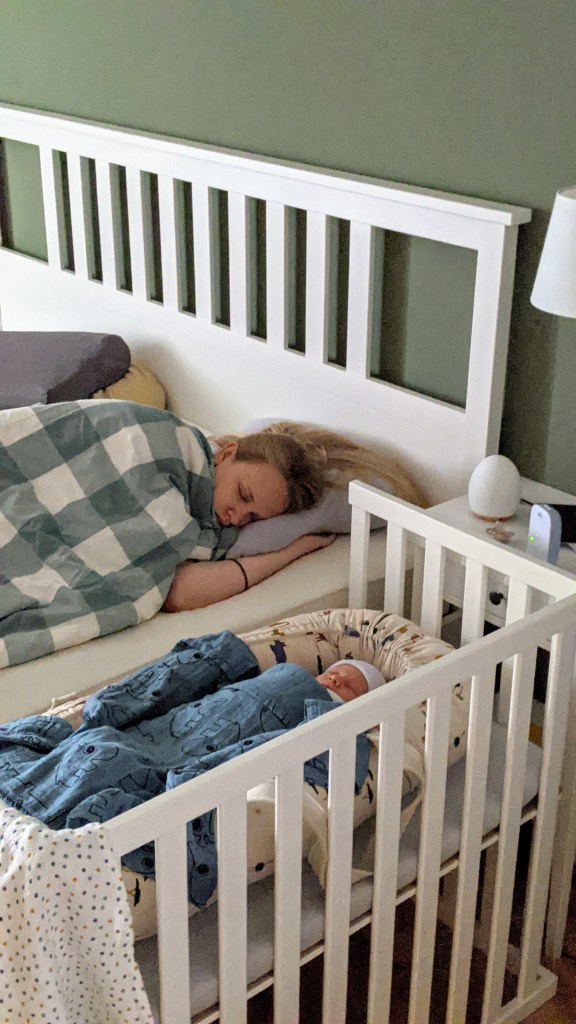
Once cleaned and redressed, we would put our culinary skills to work and burrito-wrap our baby in his swaddle and then settle in front of the TV for some cuddles and come-down after the excitement of the diaper change. Roo would drift off to the sound of canned laughter and Jim Parson’s deadpan delivery as we re-watched the Big Bang Theory. Once we were confident he was under, we would transition him to the bedroom and his small crib attached to our bed where one or both of us would join him in catching what shut-eye we could. 

If we opted not to join him, we would instead madly rush around attempting to tend to those activities of daily living we had recently performed for our son, only for ourselves. Once fed, showered, and toileted, we would collapse, alarms set for an hour’s time when we would have to wake and prepare for the next stage of the cycle. Pumping.

To encourage along the milk production, as well as to allow me the pleasure of administering life-giving nutrition to our baby even given my lactation deficit, we invested in a breast pump, which, for the uninitiated, is exactly what it sounds like. Alex would drowsily strap those suckers to her chest and they would chug away while we made conversation as if being milked in your living room was a totally normal thing. Which it quickly became. 

I would collect the produce from Alex’s efforts and measure it out into a feeding bottle with the care and accuracy of a scientist handling volatile material, ensuring we did not lose a drop of the hard-earned liquid. Once both breasts had been mechanically stimulated, we would tip-toe into the bedroom to restart the cycle and gently coax our boy back into the waking world.

For those of you playing at home, you may have already noticed this cycle leaves little room for anything else, such as, oh, I don’t know, sleep. The cycle, which approximately lasts three hours end-to-end, wheeled its way throughout our days and nights, twenty-four seven, completely uncaring that humans are not traditionally nocturnal creatures and actually prefer a good eight hour stretch if given the chance. Our son was afforded approximately two hours of sleep for every three hour cycle, but us chumps in charge of the prep and clean up were happy to catch an hour here and there when we could.

And so, at the end of our first month of our self-imposed quarantine, eyes perpetually  red-rimmed and heavy-lidded, we found our obsession slipping from all things baby to just one central theme: Sleep.

Next week’s topic: Sleep.

2020/21

It is the first morning of 2021 and I am sitting in bed drinking a cup of tea my wife made me and 2020 is done and I feel better for it.

Of course, there’s really no logic to my sense of relief. The period we called 2020 is, after all, just an arbitrarily chosen point in time. Millennia ago, some shaman determined that when the earth was in a particular position in its cycle around the sun, that the year had died, an end-date was formed, and it was deemed appropriate to celebrate the start of something new. The earth didn’t notice, of course, and just continued in its steady circle of the sun, but we living on earth thought it sounded like a good idea and have since continued the tradition of putting a full stop in our collective sentence every time the earth finds its way back to that same spot adjacent to the sun. It is random, arbitrary, and nothing really differs from 11:59, December 31st, 2020, to 00:00, January 1st, 2021. But it does help give us a sense of closure.

And, damn, but do we deserve a fictional but comforting sense of closure. The events of 2020 were anything but fictional, they were, in fact, painfully real. I won’t rehash them because we all know what they were, we all lived through them. We all watched the world close down, all read the countless news reports, watched the graphs and tallies as the number of cases grew, all closed our doors and settled in for the long wait, all obtained masks, and developed an intimate relationship with our sweatpants. 

You know what I’m talking about because you lived through it too. And it doesn’t matter if you’re reading this in a backyard in Melbourne, or an apartment in Vienna, or in bed in Beijing, because you went through it too. And as awful as the implications of that are, that this virus and its society-stopping impact managed to circumvent the world with frighteningly apparent ease, isn’t it remarkable that this goddamn year and all its weird and new and awful moments was a universally experienced phenomenon. 

I didn’t see my family this year. That is to say, I didn’t see them physically. For a full twelve months, for the entire rotation of the earth around the sun from an arbitrarily chosen point and back again, I was removed from the people who raised me. This has never happened before. I hope it never happens again. But, like the rest of the world, I adapted. I found creative ways to engage with my loved ones through digital means. I participated in video call parties, broke out of virtual escape rooms, and sat in my pyjamas at two in the morning, raising a glass of whiskey to my grandpa while attending his streamed funeral. 

It wasn’t the same, of course. Nothing can replicate the feel and warmth and comfort of a long tight hug. But it was something. It was still connection, and conversation, and laughter, and life shared, and while it’s easy to wish none of this had ever happened, instead I choose to be grateful that this all happened at a time when I could open a metal book, click a button, and see my family’s faces smiling back at me through pixels so small so as not to be seen. 

You know what I’m talking about because you lived through it too.

To say it was an emotional year is an understatement. I felt emotions I didn’t know could be felt. The casual boredom and anxiety of a lockdown. The quiet exhilaration of completing a workday in pyjamas. The eerie sensation of stepping onto a train platform and seeing only masked faces looking back at you. But the primary emotion I felt this year was frustration. 

I felt frustrated by the limitations of lockdown. I felt frustrated when an overwrought network failed and a call to my family froze. I felt frustrated trying to take a work call while my wife tried to take one too from half a metre away in our cobbled together home-office. I felt frustrated looking at the same four walls day in and day out. I felt frustrated every time I saw a nose poking over the top of someone’s mask. I felt frustrated every time I forgot to unmute myself. And I felt overwhelmingly frustrated every time there was news reports of people having parties in the middle of a lockdown, of people who knew they were infected but thought it was okay to pop into the shops, of morons claiming that wearing a piece of protective clothing was somehow impinging of their personal freedoms, of selfishness, and borders closing, and death tolls rising, and flights cancelled, and that day when I could return to my family stretching further and further into the future until it seemed to disappear over the horizon line altogether. 

I felt frustrated with a society I thought was better than this.

You know what I’m talking about because you lived through it too.

But focusing on this frustration is a choice, and a bad one. And that was something else I had to learn to adapt to in 2020, choosing where to direct my attention in a way that best served me. It was so easy to get sucked into the endless feed of headlines and the addictive horror that was the virus and its effects, and to believe the world was ending. But it wasn’t ending, only changing, and there are good parts to change if you look for them.

2020 was the year of the virus, but it was also the year I got to spend every day with my wife and best friend. Rather than break us, being confined together taught us new ways to spend time together and new ways to give each other space. It made me more grateful than ever that I found a partner who I can literally spend every minute of my life with and still want more. 

2020 was the year of the virus, but it was also the year I didn’t have to commute to work anymore and so had time to exercise. I started slow, and with short distances, but then ran longer, and faster. I ran in sweltering summer heat and pitch black winter evenings. I got fitter and felt better inside my own bones. 

2020 was the year of the virus, but it was also the year we all got crafty. We baked sourdoughs, and banana breads, and all the comfort food we needed to get through the long days. We picked up knitting needles, pencils, paintbrushes, and tools, and we made things. We took photographs and made videos, and wrote things, and read things. We found new hobbies and new ways to enjoy our time. 

And you know exactly what I’m talking about because you lived through it too.

I know nothing really differs from 11:59, December 31st, 2020, to 00:00, January 1st, 2021. I know it’s all arbitrary. But, dammit, I am still hopeful for this coming allotment of time. Not because some past shaman was right and something has died only for something new to be born, and not because the slate magically becomes clean just because we add an extra digit to the end of the calendar, but because in these last twelve months we have all adapted. We have been through an ordeal and we have learnt from it.

My hope is that we will take the collective lessons into the new year, the major groundbreaking discoveries and the intimate personal revelations. My hope is that 2021 is the year the vaccine works and we contain the virus. My hope is that 2021 is the year I get to hug my family again. But whatever 2021 brings, my hope is that I continue to grow and adapt and find new ways to connect and enjoy my time. 

And I am comforted by the knowledge that you will know what I’m talking about because you will be there, living through it too.