ENCOMIUM – PART 1

I watch my feet as I walk up the cracked and sloped path between the red-brick wall to my left and the overgrown hedge to my right. Ted’s backyard appears before me, a lawn in want of mowing, a small aluminium shed, and the odd sun-faded lawn gnome peering out from the dense brush of a bush. I shake my head and wonder why anyone would want to populate their yard with the eerily smiling porcelain figures.

Ted’s back door is a mess of flaking green paint and I stop a moment to read the sign nailed to it.

WARNING: THIS BUILDING HAS BEEN CONDEMNED AND IS AWAITING DECONSTRUCTION.

Ted told me they can’t knock the unit down until he leaves or dies, and that he has no intention of leaving. I smile at his contentment in keeping the sign in place, his complacency in spite of the words written on it. I glance at the thumb-thick cracks veining the brickwork and wonder if it wouldn’t be better for Ted to relocate. But, as he says, this is his home.

I knock and the door shakes against the brick wedging it open a hand span. The gap is for his ladies to come and go.

‘Ted!’ I call out and enter before waiting for a response. I know where Ted will be.

The stink of putrefying cat food billows up at me and I glance down at the bowl by my feet. Globs of brown muck have spilled over onto the kitchen’s scuffed linoleum, but, thankfully, there are no maggots in the bowl this time. By the smell, they can’t be far off.

‘Ted,’ I say again, ‘it’s the nurse.’ I step through the doorway to my right and into Ted’s living room. The cold and silence of the kitchen is replaced by a thick heat and the whirr of a heater’s fan, and Ted is slouched in a one-person sofa in the corner of the room. His legs are stretched out inches from the glowing filaments. One day his pants will alight.

‘Ted!’ I say louder, and the crumpled marionette of Ted’s form becomes animated as he jerks awake and looks around. Even with his advanced age he is a tall man and his knees come up high as he straightens in his chair. His watery blue eyes find mine and a smile spreads across his narrow face, his white stubble parting to either side. He blinks a few times, orientating himself.

‘Oh, hello!’ His voice still has a northern English accent despite forty years of living in Australia and I’m charmed by it immediately. ‘I must have dozed off. Now, who are you?’

The question is asked with a carefree attitude. Ted is completely unfazed at being awoken by a stranger in his living room.

‘My name’s Jonathan. I’m the district nurse. I’m just here to help with your tablets. How are you doing?’ I wonder how many times I’ve introduced myself to this man. It’s probably in the hundreds.

‘Oh, just fine. A pleasure to meet you, Jonathan. Can I get you a drink?’

His hands are already moving, looking for his cane and preparing to hoist himself from his seat. I wave a hand and assure him I’m fine. ‘I’ve already had my morning coffee, so I’m all fuelled up. Thanks anyway, mate. I’ll just have a look in your book and get your tablets ready.’

I drop my bag to the floor, place my work laptop on an empty seat, and turn to the table set against the opposite wall. Ted’s medical folder is spotted and splotched with stains, a testament to the meals he’s eaten on this small square table. I open it and put it to the side, then unlock the metal box that holds Ted’s medications. I peruse the list of drugs in the folder and begin the process of picking through the packets and bottles jumbled in the box.

‘You’re a strapping young lad,’ Ted says from behind me. I smile and turn and await his next sentence. ‘You’d make a fine soldier.’

‘You reckon?’ I ask with a smirk and he nods emphatically. Ted has told me daily for the past year that I would make a fine soldier. I don’t know what he bases this statement on; I’m not particularly tall nor heavily muscled. Still, I get a small flush of pride every time he says it, as if I’ve passed some sort of test.

‘Oh yes. I was a soldier, did you know?’

I knew. ‘Really?’

‘Queen’s guard.’ He straightens as he says it, his chest full. ‘I used to parole Buckingham Palace. Spooky place at night. Haunted, you know?’

‘That’s incredible, Ted.’ I turn back and shake a warfarin tablet from its bottle, rattling as it hits the medicine cup, then grab a box of omeprazole. ‘So you wore the hat and everything?’

‘I did, I did. And you couldn’t move.’ He raises a finger as he says this, his whole body joining in the telling. ‘Tourists would come and tie our laces together, and you had to stay perfectly still. They’d send out guards every hour to give us a drink and untie our laces.’

‘They’d tie your laces together?’ Having heard the story so many times before my incredulity is a little forced. ‘The bastards.’

Ted chortles a laugh and nods, and his eyes unfocus as he sorts through his memories. ‘And then I worked as a soldier out in the desert. Oh, it’d get cold at night out there.’ He chuckles. ‘One time I lit myself on fire!’

His declaration is designed to spark my interest and by now I know my lines well. ‘You lit yourself on fire? How did you manage that in the middle of the desert?’ Having memorised the stories means I can concentrate on sorting Ted’s tablets while still giving the appropriate responses.

‘Well, each night when we’d set up camp it would be one man’s job to dig the fire pit. This night I had dug the pit and put the fuel at the bottom,’ he stands to do the reenactment justice and I have to resist the urge to step over and stabilise him as he wavers on his feet, ‘and I lit it.’ He squats and mimes throwing a match into an imaginary hole. ‘We used oil, you see, and the fire roared.’ His hands spread in an imitation of high-burning flames. ‘I turned to get the pot,’ he chuckles at this point and does another shaky squat, ‘and my shirt tales went right in the fire.’

My face is an open expression of disbelieving shock. Of course, I know this story, but Ted is a good story teller and he has me engaged.

‘I hear a fellow call out, “Ted, you’re on fire!” I say, “What? Fire!” and I bolt off into the desert.’ He claps his hands and he’s wheezing with laughter and I laugh along with him. ‘Three men had to chase after me through the desert to put me out.’

He collapses back into his seat, a grin of reminiscence riding his lips. I’m always amazed this man can describe being burnt and find it amusing. His optimism is inspiring. I drop his final tablet into the medicine cup and carry it to him.

‘There’s your tablets, Ted. Can I get you a drink to wash them down?’

‘Oh, sure, that would be lovely.’

I nod and hand him the plastic cup, then step back through the doorway into the kitchen, careful to give the dish of cat-food a wide berth. I open his ancient fridge and pull out a carton of milk and take it to the sink. A tin of nutritional supplement power sits on the bench and I pop the lid while taking a glass from Ted’s drying rack. I study the glass and find a cosmos of dried foodstuff clinging to the walls of it. The water is icy as I turn the tap and give the glass a quick scrub, and behind me I can hear Ted standing from his chair. I glance over my shoulder and see him leaning in the doorway. He’s come looking for conversation.

‘So, tell me, Ted, what happened after you were burnt?’

‘What’s that?’ His brow furrows. He’s forgotten already, my brief absence wiping his memory clean.

‘In the desert. You were telling me you lit yourself on fire.’

‘Was I? Well. I ended up in a hospital in Libya. For a month I had to lay on my belly while the nurses changed the dressings to my back each day.’

‘A month?’ I say and look around for a tea towel. The only one in sight is dried and crusted with a lifetime of wiped-up spills. I decide a wet glass is preferable and scoop two spoonfuls of powder into it, followed by a large pour of milk.

‘A month! And then—’ I pause in stirring the mixture and look at him as he says my favourite line, ‘—my old fellah got septic!’ His cackle is infectious and my brows are high in my hairline as I laugh with him. ‘Blew up to the size of an eggplant.’

I carry the glass to Ted and place a hand on his back as I guide him into the warmth of the lounge room and to his chair. ‘No luck at all, mate. I’m sure the nurses were impressed, though.’

He chortles and knocks his tablets back like a shot, takes a gulp of his drink and settles into the cushions, a stain of milk marking his top lip. A soft curious meow sounds from the doorway and a mottled long-haired cat slinks into the room. She gives another quick meow and rubs her body against Ted’s leg. Ted’s hand drops and his long fingers run from head to tail.

‘Oh, there’s my lovely lady. How are you, darling? Hmm?’ He looks at me. ‘I’ve got three ladies: Evelyn, Lucy, and Dot. This here is Evelyn.’

‘She’s a beautiful cat, Ted.’

‘Oh yes. You are, aren’t you? I don’t where the other two are, but they’ll show up. They always do.’

I know where they are. Ted’s told me he buried Dot in the south corner of his backyard, and his case manager phoned two weeks ago to let me know they had to put Lucy down. I don’t bother reminding Ted of their deaths; he’d only forget again anyway, and he’s not disturbed by their absence.

I smile as I watch this man enjoy the texture of his cat’s soft fur, a smile on his milk-lined mouth, and listen to the low rumble of Evelyn’s purr. Ted looks up at me.

‘You’re a strapping young lad. You’d make a fine soldier.’

That persistent flush of pride reawakens again and I smile. ‘You reckon?’

‘Oh yes. I was a soldier. Queen’s guard.’

I tilt my head. ‘Impressive.’ I glance at my watch and sigh. ‘Sorry, Ted, I had best be moving on. But I’ll see you again this afternoon, okay?’ I hoist my bag from the floor to my shoulder and pick up my laptop.

‘No worries, lad, my door is always open.’ He spreads his hands wide, a universal gesture of welcome. The generosity of this man who has so little is humbling. ‘And thanks for coming by.’

I extend my arm and give him a firm handshake. I feel hard muscles in his palm amongst the knobbly joints of his fingers. ‘Thank you, Ted. You’re a good man.’

‘Not a worry.’ He gives me a grin and I nod back with one of my own.

I step into the kitchen and pause. ‘Oh, and, Ted?’ I call out. ‘I think the cat food’s about due for a change.’

‘Will do,’ his call comes back.

I pull open the door, walk past Ted’s backyard, and head down the path beside his house, my eyes finding the cracks that spread like rivers between the brickwork.
THE NATURE OF IMPATIENCE

Recently I broke up with my partner of five years. Let me assure you now, at the outset, this will not be a post describing in excruciating and uncomfortable detail my heartbreak, no, but the information is relevant because it sets the context.

In five years you set patterns, you develop routines, you build a sense of yourself that is, in part, reliant on the other person. My break up forced me out of the familiar little rut I had burrowed into. In what felt like an instant, everything well-known, every habitual instinct I had in my home became foreign and awkward. The activities and past times I used to use to fill the hours between work days were no longer available and I found myself as an unsure guest in my own home.

This is a jarring experience. The usual jokes I would make, ideas I would express, and places of comfort I would seek were no longer there. I was alone. It was just me. And I didn’t really know what to do with myself. I have hobbies, yes, but the beauty of a hobby is both in the picking up and putting down, and once I had placed my hobby down and raised my head I found myself asking, “Now what?”

The first week was spent in justified idleness. I was sad and therefore entitled to unrestricted wallowing. I would do small things to maintain the house and feel immensely proud for continuing to act like an adult in my time of hardship. People told me I was doing well and I believed them.

It was into the third week that I found myself walking up and down my hallway. The dishes were drying in the rack, my lunch was made for the next work day, and I was pacing my tiled walkway in silence. The same question came to me that has probably just occurred to you. What the hell was I doing?

The truth. I was waiting.

I know how break ups go. We talk about them, we analyse them, we watch them in countless movies and television shows. I knew the stages of grief and felt like I was moving through them at a satisfactory pace and in a satisfactory manner. And what comes after. Life, right? It’s after the shock, after the depression that the dust settles and life comes barreling in to whisk you, newly single, into the next stage of your life. This is how it had felt after previous break ups. But my previous break ups always came at a time when my life was changing anyway. The end of high school, the start of university. Now I had a full-time job, I had my own home to return to. I had unbroken routine, and life, if it was going to happen, was happening. So with life happening, why the hell was I wasting it walking up and down my hallway?

The truth. I was impatient.

A prickle began to build, a thorn of impatience growing within me that snagged every time nothing happened. When I had done the necessary tasks of caring for myself, when I had watched television, read a book, cooked and eaten, I still found myself with empty hours to fill and no real drive to fill them. I was lonely, I was bored, and I was impatient because life wasn’t rushing in to entertain me and fill the hours with action.

A month after the break up I took a week off work and reassured myself that life would begin now. I didn’t have work to blame or use as a crutch. I used the week to visit friends, to reorganise my home, to spend time with family, and gave myself room to think. To feel whatever it was I was feeling and the space to recognise it. It was perfect, and healing, and in the end I found myself back in my home, alone, with hours and hours to fill.

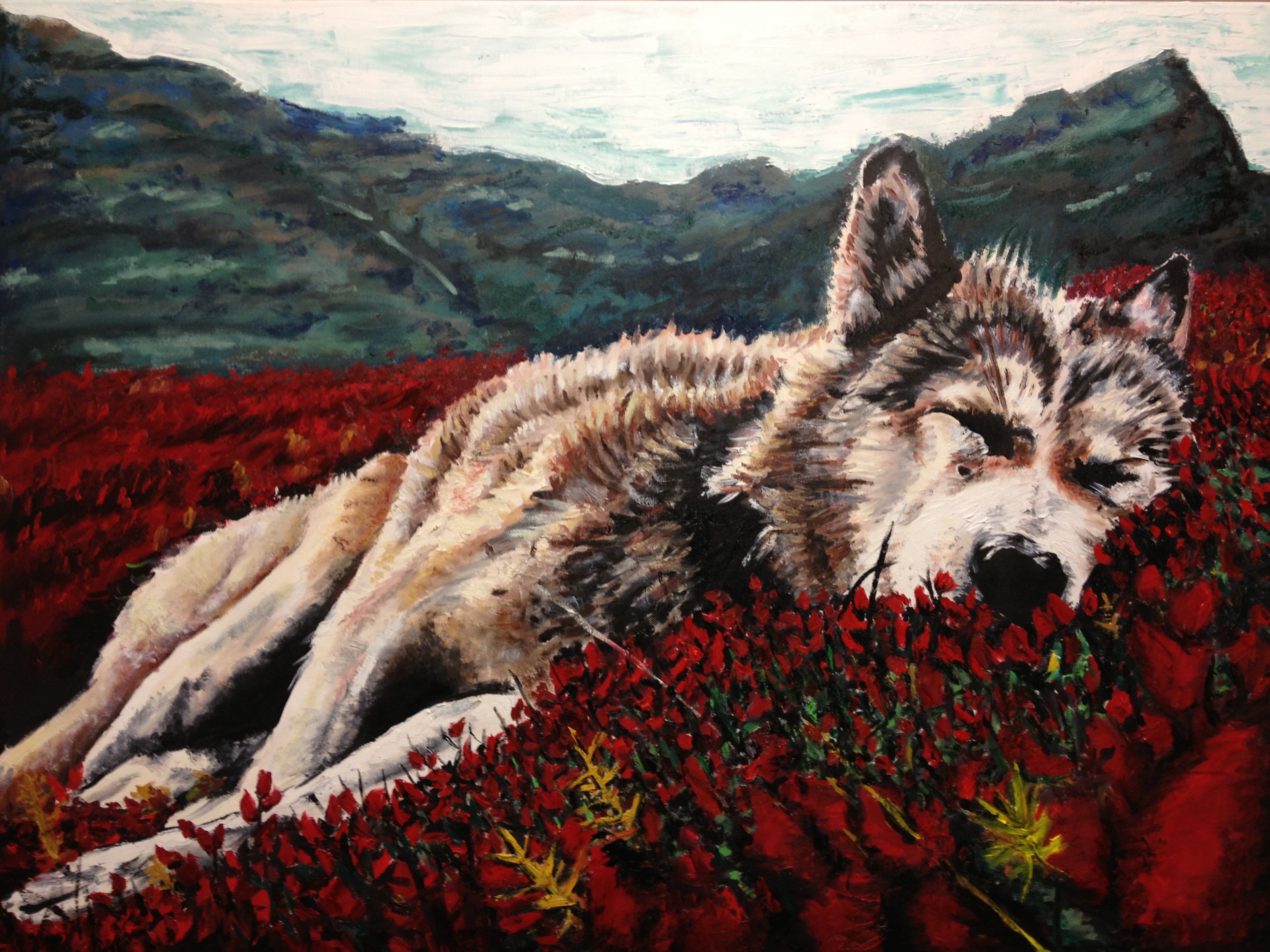
So rather than wait, rather than let the impatience build and boil, I set out to fill them. I began a painting. I didn’t have a date in mind of when to finish it, and with so much time on my hands I was in no rush to do so. I started it with an outline on a canvas. That was day one: just the outline. The next day I squeezed out one colour of oil paint and dabbed spots of black in the appropriate parts. The third day I chose three colours to work with. By day four my palette was a mess of hues and I wasted no time in setting to work. I had an audiobook playing in my ears and my hands were busy applying paint, and I was happy. I was engaged, and unaware of the hours that needed filling.

This small act of starting something open a door in my head. Months before my cousin visited wearing a beanie someone had crocheted for him, and at the time I told myself I would learn how to replicate the beanie. The burst of inspiration was diluted by the cycle of normal living, and was forgotten. But now I found myself in a situation with nothing more pressing to attend to. I started by buying wool and a needle. Since then I’ve completed ten beanies — one for each of my family and a few of my own.

I started the first steps to decorating my house. I hung photographs and put together furniture.

I started getting fit. I ran four kilometres before gasping and spluttering to a stop. The next day I ran four and a half. Yesterday I ran ten.

I started to write again.

The lesson I learnt from this experience is not to wait. Not to sit back and wonder why life isn’t unfolding the way you want it to. In short:

If you’re impatient for something to start; start something.

THE FIRST TIME

One of the most common things my patients say to me, excluding those unfortunate few who have lived with a chronic condition most of their lives, is “This is the first time I’ve ever been sick.” They say it as if daring me to believe it, because they themselves are having a hard time believing it. Their run of perfect health has inexplicably come to an end. They quote at me their perfect medical history, taking pride in their previous resilience:

“I broke my arm when I was seven, but beyond that I’ve never even seen a doctor!”

They are always surprised that their bodies have let them down. But why? Why are we taken by surprise by the fact that we are mortal, that our imperfect bodies, which until this point have been fighting like a Spartan to maintain homeostasis, have finally, inevitably, let us down?

The evidence is all around us. We watch a plethora of television shows set in a hospital that week-in and week-out cash in on the drama that is a healthy person falling sick. And the reason this is such a successful emotional hook is because we all know that such a thing is possible, even probable, when you consider the multitude of infinitesimal processes that can go wrong within our bodies. We swap stories about the health of our families and sigh in all the right places when hearing of another’s health decline. Yet we fail to, or refuse to, make the connection that we will all eventually have an occasion where we will be, for the first time, admitted into a hospital because something has gone wrong.

The irony is these same people who proudly boast about never having their blood-pressure checked in fifty years are the same people who have been walking around with increasingly high blood-pressure for the past forty years. One morning they pass out while attempting to move a couch, end up in emergency with a stroke, and later state to their nurse with complete surprise, “I’ve never even been sick before, and now all this happens!”

My favourite patient, and by favourite I mean in a sarcastic, eye-rolling sort of way, are the ones who blame accidents or hospitals for the chronic disease they have due to a lifetime of poor lifestyle decisions. One of the best examples I have of this was when a sixty-year old man told me the tale of how he procured type two diabetes. This is a man with a gut that preceded him by at least thirty centimetres, a man who thought a six-pack of sugar-covered doughnuts to be an appropriate between meal snack, and who hadn’t done regular exercise since playing football in high-school.

Out of the two of us, I thought I could give a more accurate rendition of how he procured type two diabetes.

The story went that one day in his fifties he had decided to try riding a bike again. He pumped the tyres of his old bicycle and headed out onto the streets, flushed with the joy of being back on the road with the wind in his thinning hair. Unfortunately a neighbouring dog found the image of an overweight middle-aged man on a bike to be greatly entertaining and decided to join him. While attempting to shake the dog off his tail with a mixture of swerving handlebars, wobbling wheels and wildly kicking feet, our man lost control of his bike, fractured his hip and ended up in hospital. Where, as is common procedure, they took a blood sample and discovered he had previously undiagnosed type two diabetes.

Or, as my patient put it, “Fracturing my hip gave me diabetes.”

Despite my tactful attempt to suggest that it was simply the series of events that resulted in the discovery of his disease, that it was more likely down to the fact that he has three sugars in his tea and has eight cups of tea a day that led to his diabetes, he remained resolute that the act of fracturing a bone in his pelvis gave him high blood sugar. In the end, after half an hour of discussion, I sighed, nodded, and said with complete sincerity that I hope he never fractures his other hip or else he could end up with high blood pressure. To which he responded that he already has high blood pressure, but that he got it from his mum.

We all, every one of us, will eventually find ourselves in a hospital ward due to something that has gone wrong with us physically. It may be our fault, it may be an accident, or it may be a genetic condition that has reared its ugly head in later life, but something will happen someday.

The best we can do is accept this, and in the mean time work towards being as healthy as possible, enjoying and appreciating our health while we have it, and exploring ways we can improve ourselves when a health condition becomes known.

And for god’s sake, try to look after your hips.

They may be the only things standing between you and diabetes.

REKINDLING

It’s been a little over seven months since I last posted. Within those seven months there have been some days that beat me, that took me head on and left me a groaning mess at the end. And because of these isolated incidents of universal abuse I rationalised to myself that I didn’t have to write. I could give myself the day off. I was broken, and battered, and allowed to be lazy.

But the truth is these days, these islands of hardship, were surrounded by an ocean of inactivity, where, if I’m honest with myself, a bit of productivity would have gone a long way to restoring me a little. But, as is often the case, inactivity led to even greater inactivity, until months had passed and not a word was written, which served only to deflate me further, sapping any dregs of motivation out of me and making anything that required focus and drive an impossible peak not even worth trying to surmount.

Not long ago my guilt at my own inaction reached an apex and I cracked open my laptop and started a story that had come to me in the many months before my drought of action. The story had settled into the silt of what had previously been creative juices and reawakening that part of my brain took a little coaxing. I wrote two hundred words and felt prodigious. I read those two hundred words three times over, satisfied myself that there was still a spark of writing in me, and shut the laptop lid. It was enough. No point straining something, better to ease back into it.

But, as is often the case, activity led to even greater activity. I found myself tasting the sentences of what I had written while laying in bed at night and coming up with more sentences to follow. WIth ideas and with similes. With characters and their back story. The congealed and dormant creative juices had been stirred and were starting to heat up. Even better, I was starting to wake up from the fog of justified idleness. I felt energised because I had created something and that enthusiasm could be fed back into the creative project, creating more motivation. It was sustainable energy, and it fuelled me to write.

Since then I’ve finished the story, and more importantly been satisfied with the story, and moved on to writing something a bit longer. All it took was taking that first grudging step, tapping those keys until I had one sentence, which led to wanting to write more.

And in light of that, in light of writing more and small actions leading to big results, I will endeavour to make more posts to this site, more for myself that for anyone reading.

But if you are curious, please tag along.

TWENTY-TWELVE

The ending of a year and the commencement of a new one always struck me as a strange event. A non-event. Humans determined how long it takes the earth to fully circle the sun, gave this orbit a starting point, then decided to celebrate the anniversary of this fictitious starting point. And for a long time I couldn’t figure out why we gave such an obviously invented holiday any weight.

I remember as a kid sitting on the beach and feeling an electricity as the count down began. The tension increased until the final digit fell away and everyone along the sand exploded with a tremendous “HAPPY NEW YEAR!” Bracing hugs were shared, kisses given, and fireworks would launch into the air. But as those coloured lights faded quickly from the night sky and normal conversation resumed among the adults, I remember thinking, Is that it? I don’t feel any different. Why is everyone making such a big deal? And by all outward appearances nothing had changed. The new year looked and felt suspiciously like the last year.

The anti-climax of new years turned me off the event. It seemed to me a desperate excuse to party, to drink, and generally do stuff you wouldn’t normally do. Creating an excuse to celebrate is no bad thing, but new years always came away as shallow because so much hung on it. We were closing the door to the problems of last year. We were resolving to be different and better people come the new year. But those pesky problems always seemed to find their way into the new year regardless of the closed door, and the new people we were meant to be had a lot of the flaws of the old.

There was too much pressure on this invented holiday that it ultimately failed to live up to the hype.

But as I’ve moved into adulthood and garnered adult pressures and responsibilities, the value of new years has started to emerge.

The first value: An excuse to party.

This didn’t carry much weight for a child who came home and read books and watched television, and whose major concern was a three-hour shift behind a supermarket register. The excuse to party was every weekend, and the chance to unwind wasn’t essential. I was pretty unwound to begin with.

But as an adult the chance to gather with friends, to turn off the train of thoughts linked to job, career, and finances, is like an oasis in a storm. And in that oasis you feel like resolutions are a good thing, and are accomplishable. Which leads us to…

The second value: Resolve.

New years is traditionally a time to make resolutions. An opportunity to improve. As a child I found this pointless; why wait for a made up date on a made up calendar? If you want to change, change. And why there is some truth to this, there’s also truth to the fact that after working a stressful eight and a half hour shift without a lunch break, the resolution of not eating junk and exercising is almost laughable. High fat foods and doing nothing when you get home are compulsory.

New years gives you an opportunity to reflect away from the exhaustion of work on what it is you really want to be achieving. Because while financial stability is an accomplishment, it’s not always satisfying. It’s not all you want to be doing. The fugue of endless work days makes this hard to remember, but new years is a marked point in time to stop, think, and resolve yourself to the person you really want to be. It doesn’t matter if you don’t stick to the goals word for word, only that you remember what you’re doing and why, and bit by bit, work towards them. This action is usually accompanied by reflection. Which leads us to…

The third value: Reflect.

The idea that the problems of last year will magically evaporate in the face of a new year is still a stupid one. Young me got that one right. But what new years does offer is the opportunity to reflect on those problems, to weigh them against the successes of a year, and realise that you may have done better than you thought you did. It’s a moment to summarise what’s not working, to appreciate what you accomplished, and to take those wins and losses and decide what you’ll do with them from that point onwards. And there is definitely value in this.

For me, 2012 was a big one. A year may only be a fictitious span of man-made time, but mine was an eventful fictitious span of man-made time. 2012 saw my first published work, my first purchased home, my first published illustrations, my first promotion, and my first hospitalisation. Phew. And I only really appreciated this list when I stopped to reflect, calculate, and appreciate what I had accomplished in a year.

Here’s hoping it only gets better.

Happy new year everyone, and all the best for 2013.